Watermelon Salad

Over the last year or so, I have noticed that some of the more trendy restaurants are adding or even featuring seedless watermelon in salads. I have never been a watermelon fan since I swallowed a large black seed at a very early age — and thought this is the end. . . . That memory has stayed with me. Uncompromisingly. Until recently.

In late August, Donna and I spent a few days in New Buffalo, Michigan — hardly a place one would expect to have a Damascus Road conversion.  But it happened.   At the Bentwood Tavern.  We ordered the arugula and beet salad.  And I fell in love.  Consider — arugula, small beets (of different variety), pumpkin seeds and seedless watermelon.  Diced.  With a white balsamic and olive oil dressing.   I ate it.  I enjoyed it.  Truth be told — I could’ve made a meal of it. 

In Santa Barbara, CA last week, we had lunch at a popular restaurant where I ordered the watermelon salad.   My expectations rose then fell.  The meal was outstanding though the watermelon salad was a rectangular cut of watermelon on a bed of lettuce.  Little else.  A bit disappointing.   But we moved on to San Francisco and Rose Pistola where dinner started with a roasted beet salad with pomegranates, ricotta salata cheese, a 12 year aged Balsamic and light olive oil and  . . . watermelon.  I was actually tempted to order another beet and watermelon salad for dessert.  However the other member of my party insisted on something chocolate.   That we could share.  Chivalrous to the end, I capitulated.  Chocolate. . . . . I mean when you can have watermelon??          
The Coastal Highway

Donna and I just returned from a week in California.   Two nights in Santa Barbara (the Canary Hotel).  One night at the beautiful Summerwood B&B in Paso Robles wine country.  A night in San Francisco (fabulous dinner at Rose Pistola).  And then Napa to lodge in a wonderful place called the Oak Knoll Inn — a 4 room B&B in Napa (a place to which we could easily return – and spend a few extra days).      

The drive from Santa Barbara to San Francisco along  the Coastal Highway is amazing in terms of agricultural activity.  As far as you can see — on both sides of the road for a hundred miles or more — literally everywhere —  there is a hum of activity. Trucks, tractors, workers, boxes, irrigation, cattle.   Everything moving (or moooooing).   California has 4% of the nation’s farms but is numero uno in cash farm receipts. California has 15% of the nation’s receipts for crops and 7% for livestock.  They can say what they will about the Midwest and the prairie states but California’s Central Coast is truly America’s breadbasket (and wine rack).

Fireworks – a Postscript

I have received some criticism for my posting about fireworks.  When it comes to firecrackers though, I continue to be bewildered by the fuss — and oppressive regulation.  I suffered a badly-burned finger once and had my ears ringing a few times but there were never any serious problems among my 10 year old pals.  And we did have fun. . . . .  

Let’s look at statistics.  According to a 2004 study, there were 9,600 fireworks injuries in the United States.   None were fatal and most occurred in the month surrounding the 4th of July.   http://www.pyrouniverse.com/stats.htm    This number of injuries is a drop in the proverbial bucket compared to other activities such as high school football where there were 500,000 injuries in the 2005-6 season including 16 fatalities (see http://www.sciencedaily.com/releases/2007/08/070815154430.htm ).  I have no kneecap in my right leg thanks to high school football. . . .

I try and put things like this into some logical perspective and cause/effect context.  Firecrackers for me were a hoot and generally safe.  The cherry bombs, Roman candles and such?   Okay — I agree they should be reserved for adults.  And probably limited to rural environs.   But please tell me this — would you rather allow your son to play high school football or light off some Black Cat (I still remember my favorite brand) firecrackers?  I know what I would choose. . . . .     

Fireworks

So what do you think about fireworks? Firecrackers? Cherry bombs? Should they be legal?  I was in Wisconsin this last weekend and the fireworks stores seem to outnumber cows. And the weekend festivities were punctuated by the occasional staccato of firecrackers or boom of a larger “device.”  

When I was 9 years old (and on), I loved firecrackers and fireworks.  Loved that smell of cordite.  We used to break open firecrackers, shake out the fulmenite of mercury powder into cigar tubes with homemade fins, balance them on an incline and then light a fuse sending the “rocket” skyward (often with an enormous explosion).  We would pack match heads into the tubes, pouring in the powder for more incendiary displays.  It was wonderful!  🙂  Every guy had a supply of firecrackers, cherry bombs, M-80’s and such. 

I am keenly aware of all of the arguments of the armchair howlers  (“what about accidents?”  “they can blow your finger off!”) but I still feel that fireworks (at least firecrackers) have a place in a young boy’s life.  Wisconsin and 39 other states have got it right.  Illinois – as usual (with its ban) – is marching to the wrong drummer. . . . .

Blood Type and Health

Do you know your blood type?  You should.  Thousands of years of evolution have split human blood into four basic “types”: A, B, O and AB. Each has a postive (+) and negative (-) (called “RH”) component as well.   Roughly 43 % of us are type O; 40% type A; 12% type B; and 5% type AB with interesting geographic, racial and ethnic differences in blood type and RH distribution. 

While there is speculation that blood type predicts broad personality traits (especially in Japanese studies), there is strong indication that different blood types have different vulnerabilities — and do better with certain diets.  A recent Harvard study (reported in August) confirms that certain blood types are more prone to heart disease (see http://www.bbc.co.uk/news/health-19257876).   Where one blood type does well on a meat diet, others might suffer.   

Type O is the oldest blood type in the world with the most robust digestive system.  Needs animal protein for good health.  Has trouble with wheat and gluten.   Thrives on vigorous workouts.  Less prone to heart disease.  O negative is a universal donor.

Type A has a more fragile digestive system which has trouble tolerating animal protein.  This blood type might do well as a vegetarian.  Can be lactose intolerant and anemic.  For this reason, iron and Vitamin B-12 supplements may be helpful. 

Type B has difficulty with wheat and gluten though dairy is usually just fine.  Chicken is an apparent “red flag” which can turn into a serious health issue due to an agglutinating lectin which can adversely affect the circulatory system. 

Type AB is the new kid on the block having been around for perhaps 1,000 years.  Should avoid red meat especially smoked and cured meats as AB shares the low stomach acid of Type A and diminished stomach acid leaves one more prone to stomach cancer. 

An interesting website of author Dr. Peter D’Adamo with extensive discussion on the subject can be found at  www.dadamo.com

Dearie

I just finished Bob Spitz’s delightful biography of Julia Child — Dearie. You may scratch your head when I say it was hard to put down.  It was.  What a read!  And what an amazing story of success.

Julia Carolyn McWilliams was born in 1912 in Pasadena, CA.  She attended Smith College and worked for several years as a copywriter in NY.  When World War II came along, 6’2″ Julia was too tall for the WAC’s or WAVE’s so she joined the OSS.  She was posted in Asia where in 1944 she met Paul Child – a low level career diplomat.  They were married in 1946 and Julia followed Paul as he was transferred to Paris where she became bored by the lack of things to do.  She took up cooking and attended Le Cordon Bleu — the legendary culinary institute.   At the age of 39 she began teaching cooking to American women — in her small Paris flat.  And with two colleagues, she began writing a cookbook directed to American housewives.  After nearly ten years of writing and at the age of 49, her book Mastering the Art of French Cooking was published by Knopf.   Julia’s star began to soar.  A true outlier. . . . . 

In 1962, she appeared on Boston’s WGBH — a television program designed for the staid discussion of books.  Instead of sitting and talking, Julia arrived with food and paraphernalia (including a one burner tabletop stove) and — much to the consternation of directors — she insisted on cooking an omelette.   On camera!   The producers feared no one would ever watch WGBH again.  Of course, Julia’s appearance had the opposite effect.  Her success spawned her own show “The French Chef” and Julia became a household name.     

In 2004, Julia passed away at the age of 92.  Her kitchen was moved to the Smithsonian where it is on permanent display.   Bon appetit!  

http://www.youtube.com/watch?v=vNfSJIyFMVw&feature=related

Mandatory Retirement?

Donna came home after playing bridge and said the ladies were discussing the comment of a young college student that “all people must retire at 65 to give young people jobs.”   Pretty dramatic statement.  Easy for a twenty-something to say. . . . .  

Now if I had been given the “boot” from my firm upon turning 65 (last February), who would lose?  Me — sure.  But the firm too.  I have a knowledge base which has value.    The firm would be deprived of some work.  And the firm would lose one who is reasonably effective and efficient at his job – and one who provides mentoring for other – younger – attorneys.

I’ve read that commercial airline pilots must retire at age 60 (in Europe retirement age is 65).  Now if I’m flying along at 35,000 feet and there is a sudden major emergency, would I rather have Captain Chesley Sullenberger (who was on the verge of retirement when he landed in the Hudson) or a 28 year old “newbie” sitting in the left seat?  Most of us would choose “Sully” in a heartbeat.  Or perhaps a 64 year old Lufthansa pilot.     

Dealing with this question of mandatory retirement is complicated.  What about need?  What about the 68 year old Nordstrom’s saleswoman who desperately needs her job?   What about the small shop owner who is 74?   The small town doctor who just turned 80?  Much too will depend on the benefit of retirement.  For teachers, military and public workers, there is an incentive issue since they can get pensions after a number of years.  And perhaps get another job.  And retire again. 

From my perspective, there is no all or nothing conceptualization on this issue.  Much depends on the circumstances.  I’d love to be around to ask that college student his opinion on the subject when he turns 65.  If he is let go from his job, he’ll probably sue for age discrimination. . . . .    

Sidewalks

Sidewalks.   We walk on them – they serve their purpose.   Providing a durable and predictable path from Point A to Point B. 

When I walk to and from the train station, I keep an eye on where I’m walking — looking for cracks or holes in the sidewalk.  Or those slightly elevated slabs.   That habit has helped me avoid trips and twisted ankles and to find money, jewelry, wallets and such as I reported in my post of August 2, 2012.  While I walk, I also take note of those permanent stamped impressions identifying the contractor — and the year the sidewalk was laid down.

One stony sidewalk near my home bears the weathered yet clear date “1912.”  Wow!   A century.  As I walk from the train station to my office in downtown Chicago, I pass two such markings which go back decades.  One is 1935 — six years before the U.S. entered World War II.  Another is 1947 — the year I was born.  I think of my trips downtown — with my parents.  Years ago.  I’m sure I walked here.   Then.  My parents and grandparents and even great-grandparents probably walked on these same sidewalks.  And here I am today — sharing the same space.  Walking with purpose.  On the sidewalk.       

Being a Grandfather. . . .

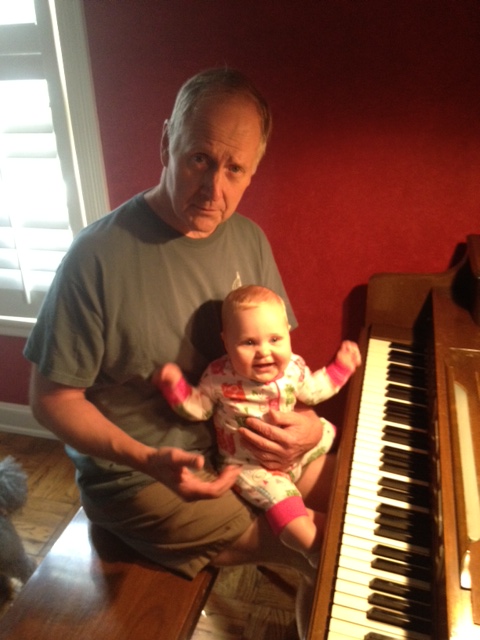
. . . . is wonderful.  Here is Eve and me. 

Eve has just finished playing Beethoven’s amazingly complex “Sonata Hammerklavier Opus 106.”  She missed perhaps four notes in the third movement’s adagio sostenuto (those darn F sharps).  This photo shows how she is delighted with her performance. . . .and the proud conductor’s approval. . . .

The Chicago Teachers Union – Part II

I heard from a close friend about my last post. He wrote that unions have served – and continue to serve – an important purpose in America.   He observes, however, that the ethic of unions has changed:   “I believe unions served a critical purpose.  Unfortunately, that purpose has begun to replicate the very greed and heartlessness that inaugurated them.  Look at the auto industry.” 

We are talking about a teachers union.  Teachers teach.  They serve as role models for our students.  And yet look at the image that is being projected by them as they strike:  they are degrading and demeaning to anyone who disagrees; they disrupt traffic;  they close streets; they use angry slogans; they have a 20 foot inflatable rat outside of school headquarters; look at and listen to their spokespersons.  And witness the demands.  Mercy!   Maybe it is that teachers unions have devolved and descended into that disappointing abyss of entertainers and professional athletes who simply “don’t care” that they are role models to young people.  It’s become obvious that education is not their primary interest.   But is it too much to ask for teachers to behave?    

What we need is respectful and ethical people on both sides.  Employers paying fair wages and workers making reasonable demands — and knowing what “fair” means.