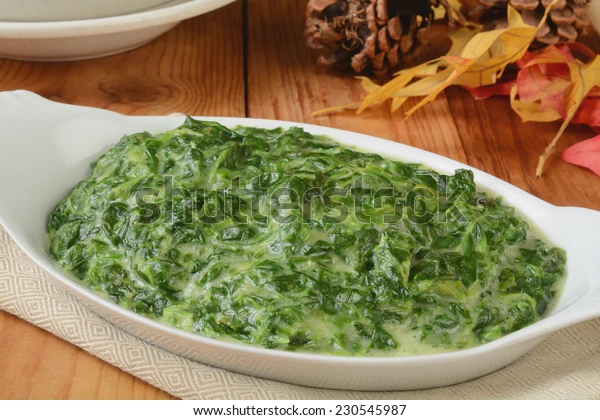
Creamed Spinach – Redux

I had a surprising number of comments to my post on “Creamed Spinach.” The dish was dubbed a “favorite” by some. One friend suggested using a special brand of hydroponic spinach (grown in water – no soil – often indoors – no stems) from Wegmans (a supermarket chain out east). Another suggested adding other vegetables, an egg and parmesan cheese to the mix. Some spoke of the Chicago restaurant icons where the best creamed spinach is served. Those mentioned include The Berghoff (a favorite for me when I worked downtown) which adds a teaspoon of chicken bouillon, two teaspoons of flour and a pinch of nutmeg. Then there was the old Red Star Inn (which closed in 1983) where Johnny the Waiter – in a black tux – would serve you on the second floor. Two other honorable mentions were E.J.’s and Landl’s in Skokie.

The friend who suggested adding other “frozen vegetables” got me thinking. So last night’s creation included some frozen organic peas (washed and nuked for 4 minutes). The dish was spectacular! Next time – a pinch of nutmeg.

Creamed Spinach

To say I “like” creamed spinach would be an understatement. I have been a creamed spinach aficionado for as long as I can remember. As a kid – I would go out for dinner with my parents. At the conclusion of the main course, the server would walk over and offer dessert – “we have chocolate pie, chocolate sundaes, chocolate cake and . . . .” I never listened since my mind was already made up. I would ask for another bowl of creamed spinach. The waiter would look at my father who would shrug his shoulders. On occasion at Louie’s Restaurant in Addison, I’d get two desserts. . . . . True. . . . .

Spinach is technically a flowering plant – native to Asia. In 2018, the world’s production of spinach was 26.3 million tons. I believe I consumed about 14% of that total (yes, on that I am kidding). Spinach is low in calories and high in nutritional value. Spinach is thought to have originated 2,000 years ago in ancient Persia. In 827 AD the Saracens introduced spinach to Sicily. Spinach first appeared in text in 10th Century medical works. And, like Popeye the Sailor Man, I attribute whatever strength I have to spinach. To quote Popeye – “spinach is full of vitamin A an’ tha’s what makes hoomans (sic) strong and helty (sic).”

If you want a special treat, try my recipe for creamed spinach: I start with half a yellow onion finely chopped and sautéed in 2 tablespoons of butter. Sautée until onion is translucent. Then add a few ounces of heavy cream and a few ounces of creamed cheese (separated). Let warm on low heat. Then sautée 10 ounces of (I prefer organic) triple washed spinach in olive oil. Once cooked – drain the olive oil (I use paper towels to help dry the spinach) and add the onion/cream and mix well. I add garlic powder and pepper. And you have creamed spinach that can accompany any meal. If you have any leftovers, let me know. . . .

Let’s Make a Deal

When I was a 27 year old State’s Attorney handling felony cases at 26th & California, we’d have maybe 20 to 30 cases on call every day. As defense attorneys stepped up when their case was called, they’d sometimes lean over and ask “can we work this out?” In other words, if a guy was brought out for a homicide in a bar fight, the defense would want to discuss the matter. Maybe reduce murder to voluntary manslaughter. Resulting in a lower sentence. And it was “let’s make a deal.” Negotiations were usually carried out in the judge’s chambers. Chatting. The judge’s office was small and defense counsel sat next to me – six feet from the judge who would lean back and say “what can we do, boys?” If we “reduced” a crime (murder to manslaughter), we would have to go downstairs for permission from higher ups in the SAO.

When I moved on from negotiating felony cases (sometimes life or death), I continued to negotiate. All the time. Meetings in person were usually held in a room – with opposing counsel sitting on the other side of a table. When I’d walk in – I would always plop down next to him (or her). They’d look over like – what the @^$@*X is he doing?? I’d say “easier to talk this way.” And I’d sometimes set a coffee cup or something in the center of the table and pause – counsel would look at me – and I’d say “that’s our problem.” Now the other side would look at me like I was demented – but I’d press on – “let’s think of that as our problem. How can we work together to resolve it?” And counsel would catch on. We’d discuss options. And nearly always resolve our differences. Coming to a solution. Let’s make a deal.

Statistically, cases filed in court are resolved 85 to 90% of the time. Why?? Because if you go to trial, there is a 100% chance that somebody’s gonna lose. And that loser could be you. Resolutions were often like drinking a warm Pepsi on a hot day. Not perfect – but satisfactory. For both sides. Let’s make a deal.

Look at the photos of negotiations going on with Vladimir Putin (a criminal who should be at 26th & California). There is a table as long as a football field with participants sitting at opposite ends. And I think to myself – if that was me going in to negotiate with Putin, I’d drag my chair over and sit next to him. And put my coffee cup in the middle of the table. . . . .

Free at Last. . . .

I was there – live and in person – when Martin Luther King delivered his speech which ended with the words “free at last, free at last, thank God a’mighty we are free at last.” It was an amazing day – but it was not at the Lincoln Memorial in August 1963. It was in Miami Beach in 1961.

When I was 14 years old, the American Lutheran Church Luther League Convention was held in Miami Beach, Florida, August 15-20, 1961. St. Mark Lutheran Church in Mt. Prospect sent a contingent of “Hi Leaguers” to this august August event. And I was one of them. Dr. King was the keynote speaker.

Dr. King’s speech was recorded – and transcribed – and can be found at https://soundcloud.com/user-238560644/dr-martin-luther-king-jr-speaking-at-the-alc-luther-league-convention-in-1961 This last few days, I revisited the transcription of that speech 61 years ago. “Powerful” is an understatement. They are words that we would be well advised to remember. And incorporate into our lives. A few examples which apply today. . . .

The world in which we live is a neighborhood, and we face the moral responsibility of making it a brotherhood. We must learn to live together as brothers or we will all perish together as fools.

All life is inter-related and we are all caught in an inescapable network of mutuality, tied in a single garment of destiny so that whatever affects one directly affects all indirectly.”

” . . . there is a voice crying through the vista of time saying to every potential Peter ‘put down your sword.’ History is replete with the bleached bones of nations. History is cluttered with the wreckage of communities that fail to follow this command.”

And he quotes John Donne – “No man is an island entirely of itself — every man is a piece of the continent – a part of the main.

The words of Dr. King are worth reading. And re-reading. Perhaps one day, “all of God’s children” can join hands – and be “free at last.

Sleeping in Frank’s Bed

[A repeat from May 21, 2017] My first Board meeting of the Frank Lloyd Wright Foundation was held at Taliesin West in Scottsdale, AZ.  Before leaving home, I asked where I should make reservations to stay.  I was told “don’t worry about it.   Just come to Taliesin.”  Soooooo . . . . on a Thursday afternoon – after the flight from Chicago – Donna and I showed up with our luggage at Taliesin West.  

After checking in, our host escorted us toward one edge of the compound.  There was a low-lying building that looked quite nice.  Our host keyed open the door and brought us in.  “Welcome to the Sun Cottage.”  It was explained that this was Mr. Wright’s home when he stayed at Taliesin.  Our escort walked us around the premises, handed us a key – and left.  

We wandered around the place.  Picking up knick knacks that were probably worth a small fortune.  I checked out the closet.  Mr. Wright (everyone calls him “Mister Wright“) still had clothes hanging on the rack.  From 1959 –  when he died.  I pulled a book – FLW’s autobiography – off the shelf and opened it.  It was penned and inscribed “To my darling Olgivanna from your husband Frank Lloyd Wright.”   I thought to myself – this isn’t Kansas, Toto. . . . . That is until we got into bed.  Mr. Wright, who was all of 5′ 8″ tall, had a bed made to his size.  My tootsies hung over the end of the bed.  The next morning, I stepped into a shower which was the size of a tiny phone booth.  My shoulders touched the sides.  And the shower nozzle was positioned at the 5’8″ mark.  You coulda sold seats for the contortions I used to soap down my head. . . . 

Depressed? Get a Cow.

Depression. Who hasn’t been depressed. I know I have. According to various medical-related organizations, there are seven (or eight) types of depression: Major Depressive Disorder (periodic symptoms); Persistent Depressive Disorder (long term, chronic depression); Postpartum Depression/Premenstrual Dysphoric Disorder; Bipolar Depression; Seasonal Affective Disorder; Psychotic Depression (includes hallucinations and delusions); and Atypical Depression (situational depression).

Depression is serious. And it is painful – for those going through it and for those who live with those who suffer. Depression can be due to genetic vulnerability, chemical imbalance or situational circumstance. Treatments vary but can include medication, electrical stimulation/shock and counseling.

I watched a TED Talk a few weeks ago on depression by author Johann Hari (13 million views). His presentation is interesting and enlightening about causation and cure. See https://www.ted.com/talks/johann_hari_this_could_be_why_you_re_depressed_or_anxious?language=en One of the vignettes related a sad, disabled farmer in a small Cambodian village and how his fellow villagers addressed his depression — and made him flourish — with a cow. There are a various ways we can help meet the deep, underlying psychological needs of our fellow man/woman. But most of all it requires understanding, compassion and knowledge that at one time or another – we have all been in the same boat.

Joe Miller’s Joke Book

[A repeat from January 6, 2013] I always wanted to be a stand up comedian — but I don’t have the legs for it.  Comedians actually run in my family.  They have to if they want to survive. . . . .

I like jokes.  Humor.  Comedy.  The Three Stooges (“are you kidding Petersen?”).  The HoneymoonersSeinfeld.  I like to laugh.   A favorite funny movie?  “Planes Trains and Automobiles.”  Or maybe it’s “Airplane.”  Or “Young Frankenstein.”  Or “The Pink Panther.”  Humor is a great medicine (see post of July 28, 2011).  One of the best.   

The person I’d like most to have dinner with?  Aristophanes (see post of August 28, 2011).  Aristophanes was the first stand up comedian in about 400 B.C.  He got in big trouble with the Emperor – Cleon – for pretending on stage that he was Cleon.  Smeared with wine.  And drunk . . . .

The first book of jokes wasn’t published until 1739.  It was Joe Miller’s Joke Book, then known as Joe Miller’s Jests or The Wit’s Vade-Mecum.  Joe Miller (1684-1738) was an English actor who played a large number of humorous/comedic parts.  When Miller died, a chap named John Motley (1692-1750) published Joe Miller’s “jests” in 1739.  It was a collection of contemporary and ancient witticisms.  The first edition had 247 numbered jokes. 

A famous teacher of Arithmetick who had long been married without being able to get his Wife with Child.  One said to her ‘Madam, your Husband is an excellent Arithmetician.’  ‘Yes, replies she, only he can’t multiply.'”   (That’s number 234) 

Joe Miller was referred to by Scrooge in Charles Dickens’ A Christmas Carol (1843) (“Joe Miller never made such a joke as sending [the turkey] to Bob’s. . . .”). 

After I croak, perhaps someone will write “The Renaissance Hombre’s Joke Book.”  I have a card file full of them . . . .

Streetwise

[A repeat from March 18, 2013 – and I continued to see Manuel standing there – every day – until I retired]

Every day when I walk to work, there is a gentleman standing in front of the Corner Bakery across from my building.  He sells Streetwise — a weekly publication.  Manuel struggles to walk – with crutches – but he stands guard outside the CB from early morning until about noon.    Rain or shine.  I usually stop to exchange a few words with him and ask him how he’s doing.  And I buy a copy of Streetwise once a week.  Streetwise sells for two dollars though my math is not always good.

Streetwise was started in Chicago in 1992 by Chicago lawyer Judd Lofchie   The mission of Streetwise is to assist Chicago area men and women, who are facing homelessness, to achieve personal stability by providing them with a combination of supportive social services and immediate access to gainful employment.  Streetwise vendors are usually trying to make a go of it.  They are not to be confused with panhandlers. 

In my post of July 11, 2012, I wrote about Henry Nouwen – the great religious/spiritual writer.  Henry Nouwen in his treatise Out of Solitude wrote “The temptation is that we use our expertise to keep a safe distance from that which really matters and forget that, in the long run, cure without care is more harmful than helpful.”   Streetwise seems to be on the right track — offering cure, the all-important care — and a strong dose of compassion.   

Having a good conversation

I watched a TED Talk the other day while pedaling furiously on a recumbent bike. It was an eleven minute offering by Celeste Headlee on how to be more engaging in conversation. The link is https://www.ted.com/talks/celeste_headlee_10_ways_to_have_a_better_conversation?language=en

Ms. Headlee is a radio journalist who has spent the last 20 years working with PBS (Public Broadcasting Service). Much of her job was to interview people. Do you want to be a better conversationalist? Ms. Headlee’s advice can be distilled into ten simple points.

Don’t Multitask – pay attention.

Don’t Pontificate – don’t start talking about your own experience when someone is sharing theirs

Ask Open-Ended Questions – who, what, where, why. . . .

Go With the Flow – be engaged

If You Don’t Know an Answer, Say So

Don’t Equate Your Experience to Theirs

Don’t Repeat Yourself

Stay “Out of the Weeds” – people don’t care about “details

Listen – Buddha said “if your mouth is open, you are not learning

Be Brief- FDR once said “Be sincere, be brief, be seated

Night

[Timely repeat of May 13, 2020] It’s a Wednesday evening.  You’re at home having dinner with your family.  Smiling.  Hearing stories from your children about their day.  And the doorbell rings.  Again.  Again.  Sharp banging on the door.  You put your napkin on your chair – get up and answer the door.   Seven hard-looking men in uniform, carrying guns, are there.  One, an officer, spits out the words “you have one hour to pack.   Be outside in one hour.”  He turns on his heel while the six men press into your home.  Guns leveled.  And your dinner begins to cool. . . . .

This scenario happened over.  And over.  And over again from 1939 to 1945 for those in Europe who were Jewish.  Once outside the door, often families were separated.  Sobbing children dragged away from hysterical parents.  Occasional shots rang out.  An infant might be tossed in the air and used for target practice.  Families stuffed into trucks or trains.  And transported to their death.  During the Holocaust, 6 million Jews – two thirds of Europe’s Jewish population – were murdered.  Elie Wiesel’s classic Night recounts a small chapter of the horror.  

The United Nations gives a smiling pass to China, Russia, Iran, Saudi Arabia, and other totalitarian governments.  The United Nations Human Rights Council includes Sudan, Pakistan, Somalia, Libya and Venezuela.    Who do they condemn?  Israel.  A lone democracy in a troubled region.  A nation trying to survive despite the violent networks that surround them. 

Increasing numbers of people – even supposedly educated elites in academia – rise up and spew hatred at Israel and the Jewish community. I mean really?  

There are 2.1 billion Christians in the world.  1.8 billion Muslims.  One billion Hindus.  And 14 million Jews.   And who gets it in the neck – from increasing numbers of people in Europe, the Middle East and even America?  Read my post on anti-semitism (June 1, 2019). 

It’s a Wednesday evening.  You’re at home having dinner with your family.  And there’s a knock at the door. . . . . .  

Night.